Sixty-Five Billion
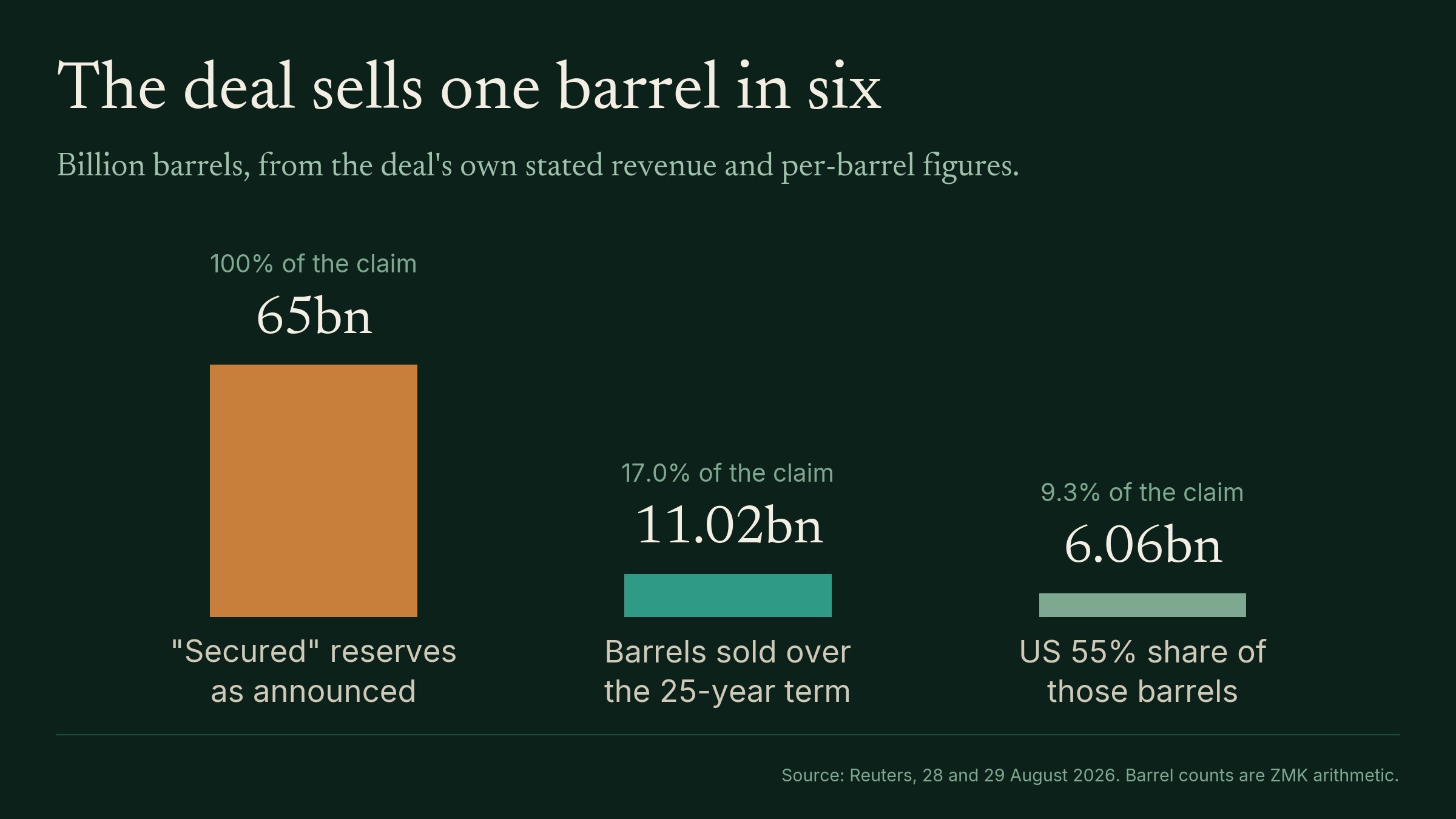
Washington announced majority control of more than 65 billion barrels of Venezuelan crude. Caracas published the revenue arithmetic behind the agreement. Divide it out and the deal sells eleven billion.

The number that was announced
On 28 August the President of the United States announced that Washington had secured majority control of more than 65 billion barrels of Venezuela's proven oil reserves, at no cost to the American taxpayer, through a partnership with private business.2 Secretary of State Marco Rubio put the accompanying private investment at nearly $100 billion and said the arrangement would lower American gasoline prices.2
Venezuela does hold among the world's largest proved crude reserves on the official count, as much as 300 billion barrels, which the Congressional Research Service reports using the Energy Information Administration's definition of oil recoverable under existing economic and operating conditions.1 The relevant question is what that number measures. Rystad Energy's head of emerging markets wrote in January that the headline figure of more than 300 billion barrels has always been more political than economic, and that the volume realistically and economically recoverable is far smaller, though still very large by global standards.3
That is the independent view of the pool. The 65 billion barrels announced is a claim on a share of it, and the claim was published without a reserves report, an operator, a signed contract or a production schedule.
The arithmetic Caracas published
Caracas published the numbers Washington did not. Interim President Delcy Rodríguez told state television that the agreement runs 25 years across 17 strategic oilfields, targets more than 1.5 million barrels per day, and would generate about $209 billion for the Venezuelan state at a $65 benchmark price, with roughly $19 of each barrel produced and sold flowing to Venezuela.2
Divide $209 billion by $19. The agreement sells 11.0 billion barrels across its term.
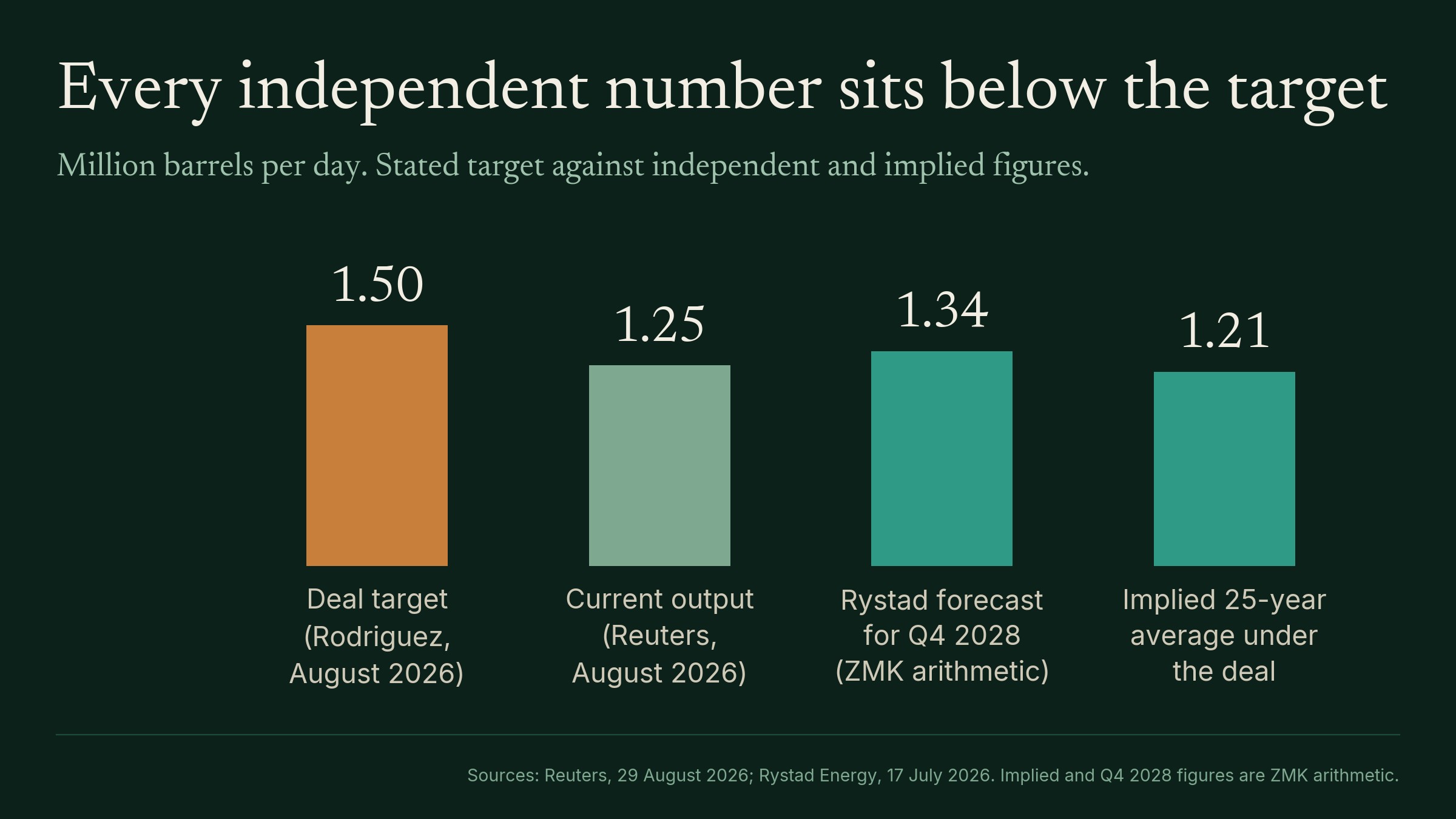
That is 17 per cent of the 65 billion announced. Spread across 25 years it averages 1.21 million barrels per day. Venezuela currently produces about 1.25 million barrels per day.2
The direction of that gap does not depend on the fiscal arithmetic at all. Producing 65 billion barrels inside a twenty-five-year term requires 7.12 million barrels per day sustained for the full period. That is more than twice the roughly 3 million barrels per day Venezuela was producing when Chávez took office in 1999, and it has never been approached since.1
Rodríguez was careful, and the care deserves recording: she called 1.5 million barrels per day an initial goal relating solely to the bilateral agreement, with eight greenfield blocks beyond it. Her revenue arithmetic is nonetheless the only quantified statement either government has made, and it describes an average below current output.
Apply the 55 per cent effective interest a US official described and the American share is 6.06 billion barrels, an average of 664,000 barrels per day.2 The United States was already importing Venezuelan crude before the agreement, and Venezuelan output had been rising from its 2020 low since before any of it was signed.11
Rystad's own forecast, published in July, has Venezuelan crude output growing about 194,000 barrels per day, or 17 per cent, between the fourth quarter of 2025 and the fourth quarter of 2028, and notes that the growth comes primarily from existing producing assets rather than new discoveries, so operational execution rather than resource availability sets the pace.4 That implies roughly 1.34 million barrels per day by late 2028.
The molecule and the money
Orinoco crude is not oil in the sense the headline implies. It is extra-heavy, cannot move through a pipeline undiluted, and cannot be sold until an upgrader lifts it to a marketable specification.7 Around three-quarters of Venezuelan output through 2028 is expected to be heavy, extra-heavy crude and bitumen, with the Orinoco belt accounting for roughly 60 per cent of the total.4
There is a real industrial logic here, and it should be stated plainly. US Gulf Coast refineries are configured for heavy sour barrels and Venezuelan cargoes arrive on short lead times. Rystad expects 400,000 to 500,000 barrels per day of Merey to displace close to 5 per cent of Gulf Coast intake, reducing reliance on Middle Eastern high-sulphur supply and disadvantaging Chinese buyers of discounted Venezuelan crude.6 That is a genuine strategic gain. It is also a trade-flow argument, not a reserves argument, and it does not require 65 billion barrels to work.
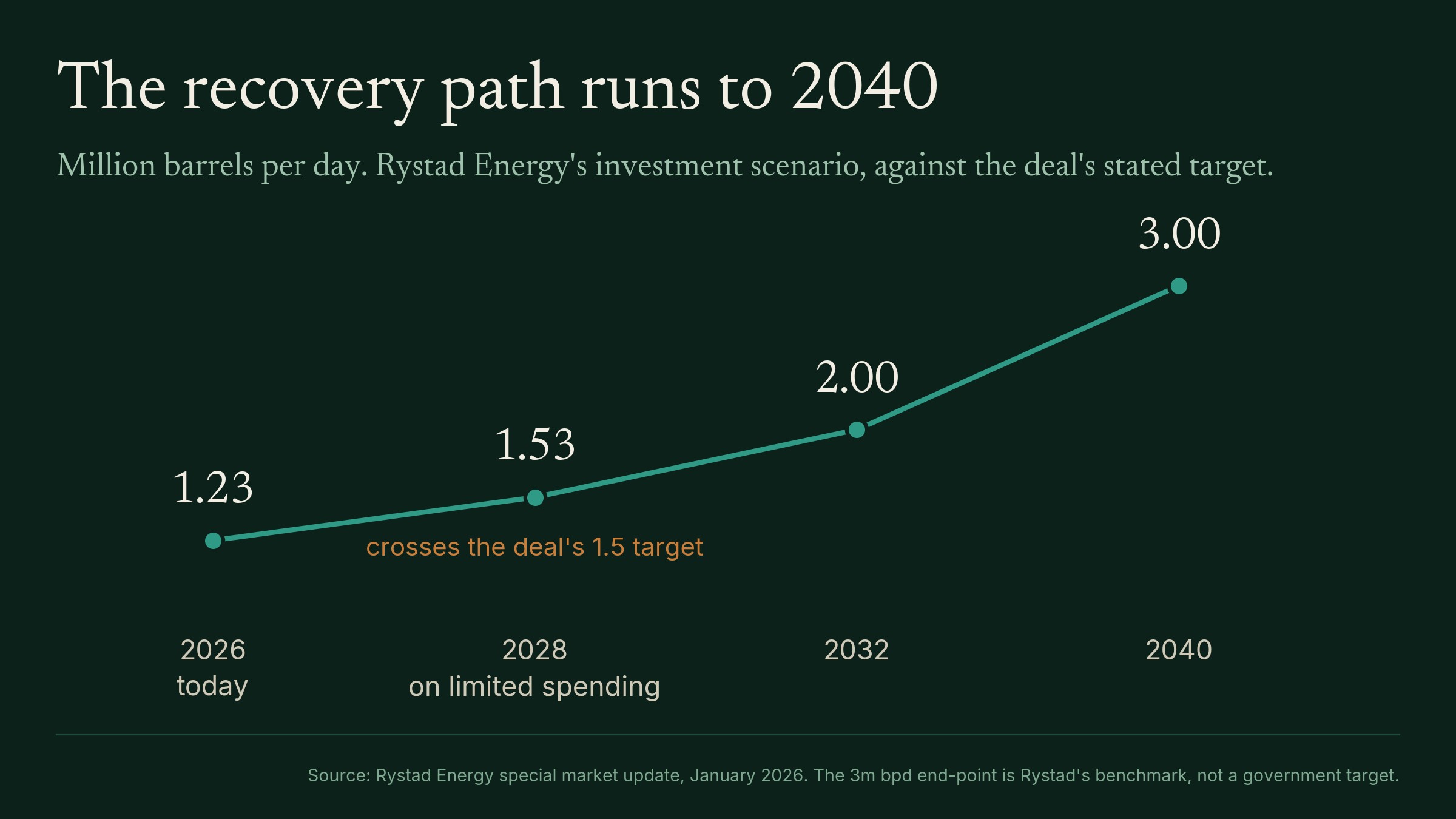
The capital requirement is documented by the same firm, and it needs stating carefully. Rystad estimates that around $53 billion is needed over fifteen years simply to hold Venezuelan output flat at 1.1 million barrels per day, that only 300,000 barrels per day of additional supply can be restored within two to three years on limited spending, and that going beyond 1.4 million barrels per day would require $8 to $9 billion a year from 2026 to 2040 on top of that.5
The often-quoted figure of more than $180 billion belongs to a different question. It is Rystad's costing of a return to 3 million barrels per day by 2040, a level neither Washington nor Caracas has adopted as a target.5 Caracas has said 1.5 million for this agreement. Comparing the announced $100 billion against $180 billion would measure the deal against an ambition it never claimed, and this note does not do so.
What the trajectory shows instead is timing. On Rystad's own path, the near-term recovery reaches the deal's 1.5 million target around 2028, 2 million arrives in 2032 and 3 million in 2040.5
The most important fact in the announcement is who declined. Washington approached ExxonMobil and ConocoPhillips to return to Venezuela. They did not commit, citing legal, security and infrastructure risk, and the Pentagon's Office of Strategic Capital was brought into the structure only afterwards.8 When Maduro was captured in January, the first commercial movers were the trading houses Vitol and Trafigura, who take cargo risk rather than twenty-five-year capital risk.9
The firms that allocate upstream capital for a living assessed these barrels and did not commit. The same barrels were then announced as a historic victory.
What the taxpayer receives
The stated destination for the crude is the Strategic Petroleum Reserve, which held 298.7 million barrels in August against an authorised capacity of about 714 million.10 Filling it takes roughly 415 million barrels, 0.6 per cent of the 65 billion announced.
At the pump the number is smaller still. Goldman Sachs modelled $4 per barrel of downside to 2030 oil prices in a scenario where Venezuela reaches 2 million barrels per day.12 At standard pass-through that is 9.5 cents per gallon. The American national average has risen 88 cents in twelve months, to $4.09.13
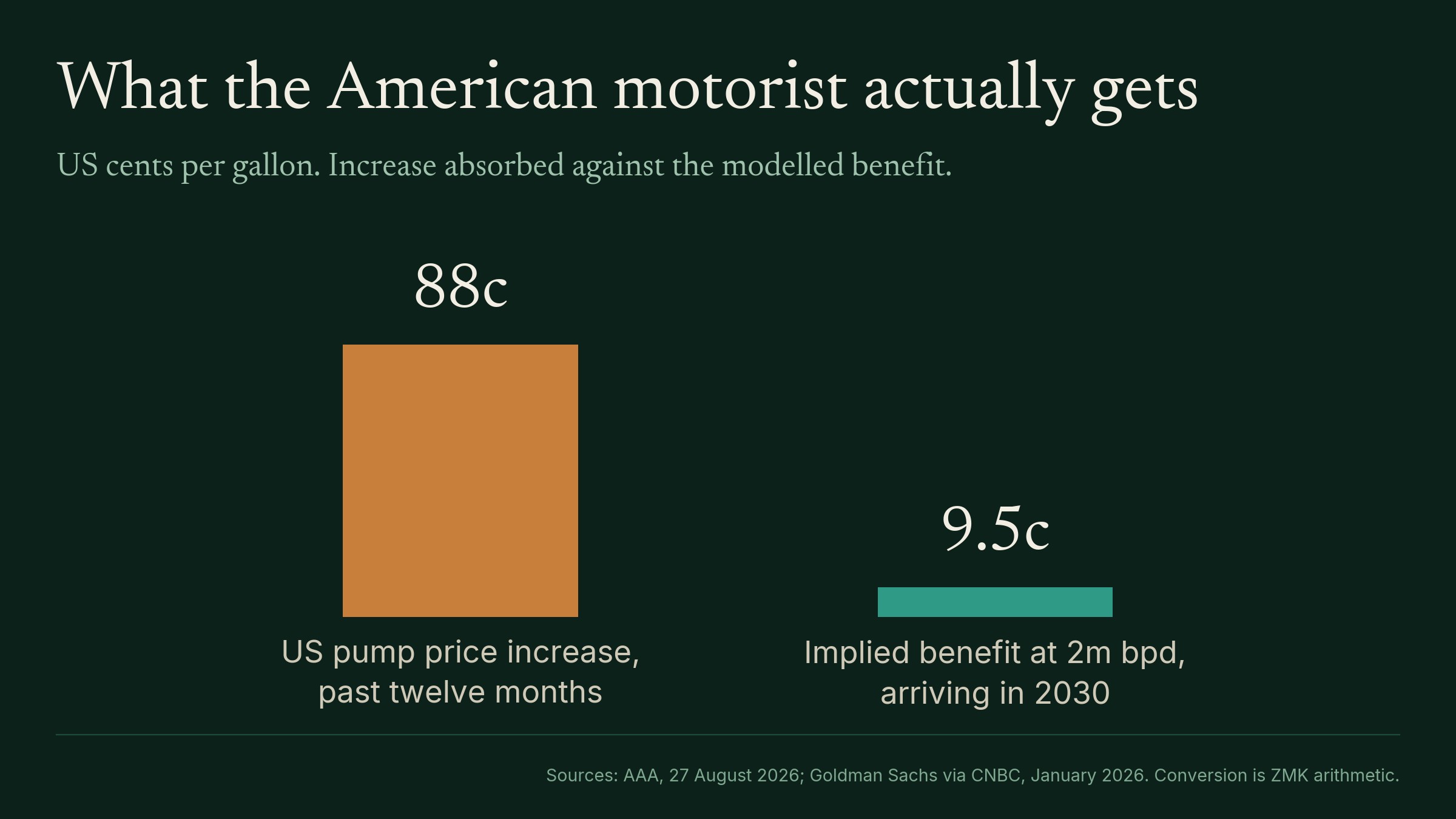
The modelled consumer benefit recovers about a tenth of the past year's increase, and arrives in 2030.
The illusion of control
One agreement has been given three descriptions in three days. A US official described a 100-year lease; Rodríguez said 25 years.2 Washington briefed a 55 per cent effective interest; the Wall Street Journal reported 35 per cent taken through penny warrants, and the Pentagon's chief spokesman said the Office of Strategic Capital does not take equity stakes in private companies at all.8 No text of the agreement has been published by either government.
Beneath the contradictions sits the structural problem. Venezuela signed long-term contracts with ConocoPhillips and ExxonMobil in the 1990s and expropriated them in 2007. That expropriation produced an $8.7 billion ICSID award in March 2019, which Venezuela failed to annul in January 2025 and which US courts are enforcing against PDVSA's Delaware holdings.141516
Washington has announced a twenty-five-year concession at a state take of roughly $19 on a $65 barrel, agreed with an interim government installed after a US military operation, in a country whose last comparable contracts were expropriated within a decade and whose oil cash flows already carry enforceable judgments.
Signed paper is not ownership. It is a claim on ownership, priced by the counterparty's continued willingness to honour it. That willingness is the one variable no term sheet controls, and it is the variable that decides whether any of this reaches an income statement.
The operators who compound capital through this cycle will price the counterparty before they price the barrel.
The consensus has bought the headline. The arithmetic is still available at the original price.
This is the terrain ZMK Advisory works. We take the number the room has stopped questioning, re-derive it from the primary document, and tell principals which part of the announcement will not survive contact with the production schedule.
- 1 Congressional Research Service, "Venezuela Oil Sector: Context for Recent Developments," In Focus IN12637. Non-partisan research service of the US Congress. Source for Venezuela's proved reserves on the Energy Information Administration's definition, and for production of approximately 3 million barrels per day at the start of 1999. https://www.congress.gov/crs-product/IN12637
- 2 Reuters wire, "Venezuela's interim president says US energy deal will last 25 years," 29 August 2026, carried by CNBC. Source for the 25-year term, the 17 oilfields, the 1.5m bpd target, the $209bn state revenue figure, the $19 per barrel payment, the $65 benchmark price, the 55 per cent effective interest and current output of about 1.25m bpd. https://www.cnbc.com/2026/08/30/venezuelas-interim-president-says-us-energy-deal-will-last-25-years.html
- 3 Rystad Energy, W. Schreiner Parker, "Change in Caracas, but will it be enough to revive ailing oil industry?", 29 January 2026. Source for the characterisation of the headline reserve figure as more political than economic. https://www.rystadenergy.com/insights/change-in-caracas-but-will-it-be-enough-to-revive-ailing-oil-industry
- 4 Rystad Energy, "Venezuela's upstream revival: turning policy momentum into production growth," 17 July 2026. Source for growth of about 194,000 barrels per day, or 17 per cent, from Q4 2025 to Q4 2028, and for the heavy and extra-heavy share of output. https://www.rystadenergy.com/insights/venezuelas-upstream-revival-turning-policy-momentum-into-production-growth
- 5 Rystad Energy, "Rystad's Take: in conversation with our CEO," January 2026. Source for the figure of more than $180 billion to restore output to 3 million barrels per day, the $53 billion needed to hold output flat, and the 300,000 barrels per day restorable within two to three years on limited spending. https://www.rystadenergy.com/insights/rystad-s-take-in-conversation-with-our-ceo-january
- 6 Rystad Energy, "US eyes on Venezuelan heavy crude: refining flows reset, China marginalized," January 2026. Source for the 400,000 to 500,000 barrels per day of Merey expected to displace close to 5 per cent of US Gulf Coast intake. https://www.rystadenergy.com/insights/US-eyes-on-Venezuelan-heavy-crude
- 7 Petroleos de Venezuela S.A., Form 20-F, filed with the US Securities and Exchange Commission. Primary filing describing the dilution and upgrading chain for Orinoco extra-heavy crude. https://www.sec.gov/Archives/edgar/data/0000906424/000110465905047833/a05-17375_120f.htm
- 8 Wall Street Journal reporting on the financing structure and on the approach to ExxonMobil and ConocoPhillips, 29 August 2026, carried by Reuters. https://finance.yahoo.com/energy/articles/pentagon-35-stake-venezuela-oil-035001573.html
- 9 Reuters wire, "Trading houses beat US majors to first deals for Venezuelan oil," 12 January 2026, carried by MarketScreener. https://www.marketscreener.com/news/trading-houses-beat-us-majors-to-first-deals-for-venezuelan-oil-ce7e58dadd8dfe25
- 10 Congressional Research Service, "The Strategic Petroleum Reserve," IN12542. Source for authorised capacity of approximately 714 million barrels. https://www.congress.gov/crs-product/IN12542
- 11 US Energy Information Administration, Venezuela country analysis. Independent statistical agency of the US Department of Energy. Source for the trajectory of Venezuelan output and US imports. https://www.eia.gov/international/analysis/country/VEN
- 12 Goldman Sachs estimate of $4 per barrel of downside to 2030 prices should Venezuela reach 2 million barrels per day, reported by CNBC Africa, 5 January 2026. A bank's scenario rather than an official projection, and published before the closure of the Strait of Hormuz. https://www.cnbcafrica.com/2026/venezuelas-oil-supply-to-rise-in-years-ahead-and-depress-prices-say-analysts
- 13 AAA national average retail gasoline price, 27 August 2026. https://gasprices.aaa.com/
- 14 UNCTAD Investment Policy Hub, ConocoPhillips v. Venezuela, Investment Dispute Settlement Navigator. United Nations Conference on Trade and Development. https://investmentpolicy.unctad.org/investment-dispute-settlement/cases/245/conocophillips-v-venezuela
- 15 International Centre for Settlement of Investment Disputes, ConocoPhillips Petrozuata B.V. and others v. Bolivarian Republic of Venezuela, ICSID Case No. ARB/07/30. World Bank Group. https://icsid.worldbank.org/en/Pages/cases/casedetail.aspx?CaseNo=ARB/07/30
- 16 International Institute for Sustainable Development, Investment Treaty News, "ICSID tribunal awards ConocoPhillips USD 8.7 billion plus interest in dispute with Venezuela," 23 April 2019. https://www.iisd.org/itn/2019/04/23/icsid-tribunal-awards-conocophillips-usd-8-7-billion-plus-interest-dispute-venezuela-gregg-coughlin/
Note on sources. Institutional sources are preferred throughout, and each citation names the body that produced the fact and the outlet that carries it, so that no link resolves to a publisher other than the one cited. The deal's commercial terms rest on the Reuters wire report of Interim President Rodríguez's address of 29 August 2026, which remains the only quantified statement either government has made. Reserve and production context is taken from the Congressional Research Service and the US Energy Information Administration; the arbitration record from UNCTAD, ICSID and the International Institute for Sustainable Development; the upgrading chain from PDVSA's own filing with the Securities and Exchange Commission; and the market analysis from Rystad Energy's published notes rather than from wire copy carried by aggregators. No text of the agreement itself has been published by either government, and nothing here asserts that any party has made a false statement.
ZMK's own arithmetic. Seven figures in this note are derived rather than disclosed. Dividing the $209.335bn of stated state revenue by the stated $19 per barrel gives 11.02 billion barrels, and across 9,125 days that averages 1.208 million barrels per day. Applying the 55 per cent effective interest gives 6.06 billion barrels, or 664,000 barrels per day. The 7.12 million barrels per day required to produce 65 billion inside the term, the roughly 415 million barrels needed to fill the Strategic Petroleum Reserve, the 1.34 million barrels per day implied for the fourth quarter of 2028, and the conversion of $4 per barrel to 9.5 cents per gallon are likewise ZMK's calculations from the figures cited. The barrel count is invariant to the production profile, since volume is revenue divided by the per-barrel take however it is distributed in time.
The assumptions behind that division, and their direction. Two of the three are conservative. Should the $209.335bn include state revenue beyond the per-barrel payment, such as income tax, bonuses or dividends from state participation, the implied volume falls: at seventy per cent it is 7.7 billion barrels, or 12 per cent of the 65 billion announced. Should the $19 be an early-period rate that rises as costs are recovered, the lifetime average take is higher and the volume falls again. The third runs the other way. The calculation treats the $209.335bn as an undiscounted total; were it a present value the nominal sum would be larger and the implied volume would rise, to roughly 30 billion barrels at a ten per cent discount rate. Two things favour the undiscounted reading. Rodríguez quoted a flat $65 benchmark price, which indicates a straight multiplication rather than a discounted model, and on a present-value reading the nominal figure would be near $577bn, which a government announcing an agreement would have every reason to quote instead. That is an inference about incentives rather than a fact, and it is stated here so the reader can weigh it. None of these figures is a production forecast.
Exhibits. The four exhibits are original charts by ZMK Advisory. Each carries its own source line on its face and reproduces no third-party material.
Interests. ZMK Advisory holds no position, long or short, direct or derivative, in any company named in this note. It has not been engaged by any party to the agreement discussed, by any of the companies named, or by any lender or adviser to a live transaction involving them.